JD.com × Ceconomy: a stress test for European market logic

"The assessments sometimes differ quite significantly from one another."
— Thomas Pool, Editor-in-Chief, LogReal Direkt
Pool is referring to two perspectives in the current issue of LogReal Direkt on one of the most interesting potential deals of recent years: JD.com taking a stake in Ceconomy (MediaMarktSaturn).
My own contribution — "Kein Preiskampf, sondern Systemkonkurrenz" (Not a price war, but systemic competition) — sits on page 16. Prof. Dr. Christoph Tripp's interview about JD.com's chances in Germany runs on page 20. Reading them side by side, I was struck by how differently the same market movement reads depending on which altitude you look at it from.
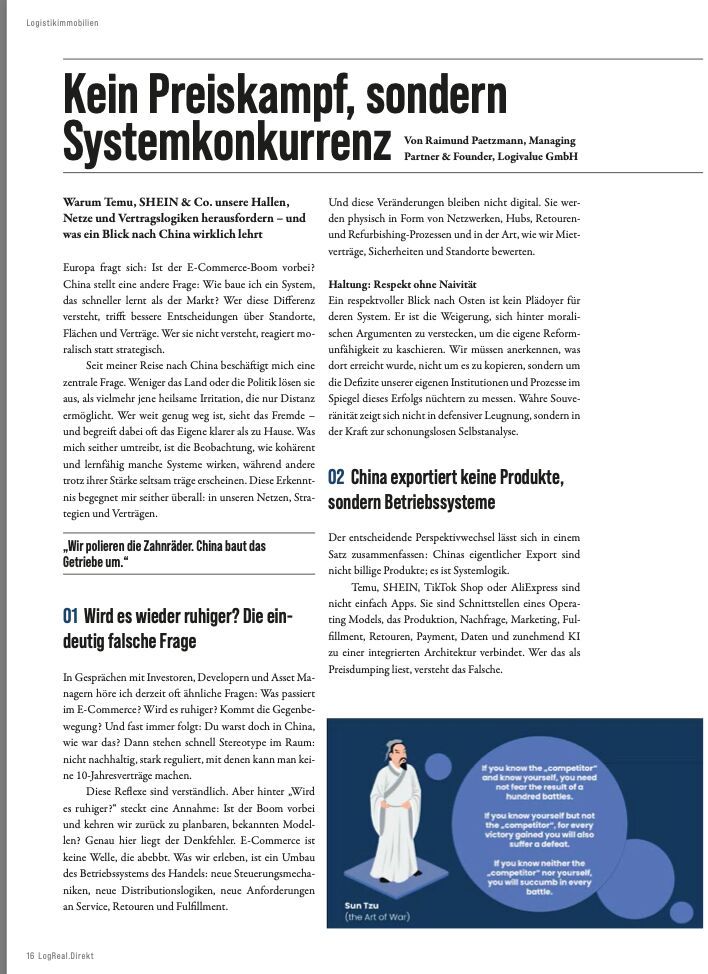
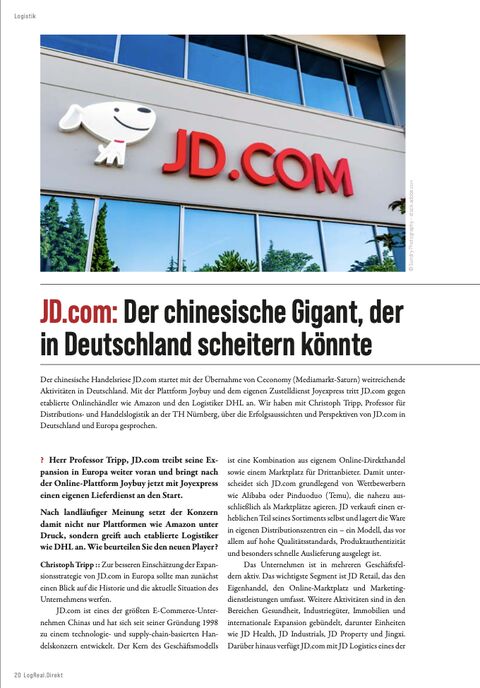
Two angles, one challenge
Prof. Dr. Christoph Tripp — the operational view
Christoph delivers his usual razor-sharp analysis of the barriers to market entry in Germany and the wider European market. He explains why the Chinese "trial-and-error" approach hits limits here, and why our highly optimised KEP (courier, express, parcel) networks are a formidable hurdle for a last-mile player like JoyExpress. Every point he makes is valid; his analysis is an essential grounding for the conversation.
My angle — systemic competition
My perspective looks past today's JD.com specifically and into a bigger question: Temu, SHEIN, TikTok Shop, AliExpress — these are not simply new platforms competing on price. They are the customer-facing surface of a completely different operating model, one in which production, demand signal, fulfilment, returns, payment, and increasingly AI are welded into a single integrated architecture.
China does not export products. It exports operating systems.
If you read the headline numbers as price dumping, you miss the actual story: a shift in how retail, logistics, and real estate are structurally organised.
We are polishing the cogs. China is rebuilding the gearbox.
Anyone trying to understand what is coming at us in the medium term should not underestimate that shift.
Back to JD.com: the Learning Synergy
The decisive factor in a JD.com–Ceconomy deal might not be distribution, KEP capacity, or urban last-mile economics. It might be Learning Synergy — the potential of a true partnership between equals.
What if this acquisition produced a new, more professional, AI-driven form of trial-and-error? An entire management generation inside Ceconomy could gain exposure to a fundamentally different way of thinking about retail operations — while JD.com learns what it actually takes to operate inside European customer trust, labour relations, and regulatory environments.
If both sides take each other seriously, a feedback loop emerges that neither side can build alone. At that point it is no longer about market expansion. It is about a joint evolution of commerce.
Why this matters for logistics real estate
From where we sit at Logivalue, the implication runs deeper than the M&A headline. A vertically integrated, demand-pull operator behaves differently in real estate:
- It underwrites sites against a different set of variables — turnover velocity and SKU breadth, not just rent per square metre.
- It automates earlier, because the operating model assumes automation is the input, not the upgrade.
- It clusters differently — urban micro-fulfilment around high-density catchments rather than large regional DCs serving everything.
- And the effects are not purely digital. They show up physically: in networks, hubs, returns and refurbishment processes, and in how we price leases, write lease covenants, and value locations.
If JD.com successfully imports even parts of its operating model into Ceconomy, investors holding large-format retail and logistics real estate will need to re-read their occupier pool through that lens.
Respect without naïveté
A respectful look east is not an argument against European standards or in favour of copying. It is a refusal to hide behind moralising arguments to mask our own reform-inertia. Real sovereignty does not come from defensive denial; it comes from the willingness to do a brutally honest self-analysis.
Acknowledgements
With thanks to Thomas Pool and Sevan Kartun at LogReal Direkt for the platform, and to Christoph Tripp for the conversation. The two pieces genuinely reward being read side by side in the e-paper — pages 16 and 20.
Discuss the operating model
If you are underwriting logistics or retail real estate into a future shaped by vertically integrated, demand-pull operators, we are happy to compare notes.